Choosing a Dive Torch
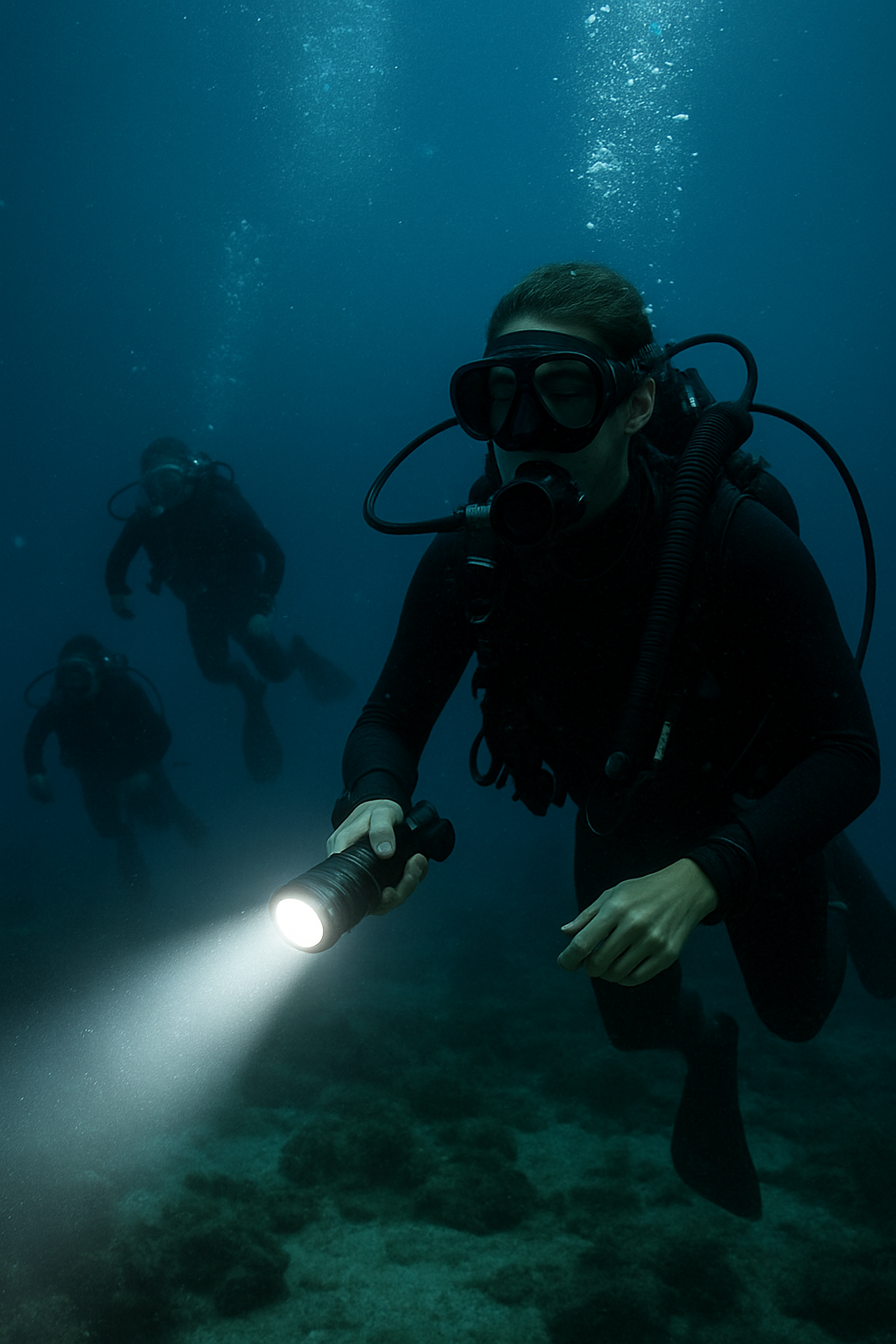
Choosing a Dive Torch
Lighting technology has evolved rapidly over the last decade, with LEDs (light emitting diodes) becoming the technology of choice for most lighting applications. Two of the fundamental areas that have seen significant improvement are the light intensity of LEDs and capacity of batteries to power them.
As a result, dive torches have become somewhat specialised, and it is important to first consider the application(s) of the dive torch, before selecting one.
Common Uses of Diving Torches
Underwater torches are commonly used for:
Improved lighting for daytime dives, where ambient light is compromised by depth, cloud cover, water clarity or overhangs. At depth, water filters out the light spectrum selectively (red, then green) such that the true colour of objects is not visible without a full spectrum torch being used to fully illuminate nearby objects.
Night dives, where the diver is effectively relying on the light to fully illuminate his or her dive.
Still camera lighting. Although it is common for still cameras to use flash lighting, a “pilot” light is usually required to sufficiently illuminate the scene ahead of time to allow variable focus cameras to track in the focus. The flash light is then used during photo acquisition to provide illumination.
Video camera lighting. Video cameras ideally want even illumination over a scene. In order to evenly illuminate a scene, the Field of View (FOV) of the light needs to be matched to (or exceed) the FOV of the camera. If this is not done, the video tends to be highly overexposed in regions, while dark in others. Many underwater video cameras provide wide FOV, or allow for wide angle lenses to be added, so video camera beamwidths of 150 degrees or more may be necessary.
How Many Lumens Do I Need?
Torch light is subject to the same filtering effects as ambient sunlight in the underwater environment. As a result, full spectrum light from torches is greatly attenuated and filtered after penetrating only a few meters of water. Casting full spectrum light tens of meters, as one could do in air, is simply not possible underwater, especially in the clarity of Cape Town’s sea water.
There are two ways to make torches illuminate further: focusing available lumens into a narrower beam using a lens, or generating more lumens. In general, reducing the beamwidth reduces the usefulness of a torch at effectively illuminating wider scenes (this is especially bad for video, but a highly focussed beam may struggle to illuminate larger objects), so generating more lumens is perhaps a better option. A torch with a wide beamwidth, on the other hand, can result in accidental blinding of other divers in your vicinity.
For lensed (narrower beam) torches, 1500-2500 lumens is perhaps a sensible target in terms of brightness. Significantly less, and lighting may be insufficient. Too much more, and battery life or size may be an issue. For wide angle/unfocussed torches (video lights), more lumens may be required, since the lumens are spread out over a wider area. A good target might be 2500 (bare minimum) to 5000 lumens for a video light.
Powering a Dive Torch
More lumens usually requires more energy, and generally increases the cost of a torch: Low intensity torches can be powered for multiple dives using disposable battery technology (AA or AAA), whereas higher light intensities typically require high energy density batteries, such as Lithium Polymer rechargeable batteries, that are more expensive and may only last one or two dives.
Battery replacement or recharging can be an important consideration when choosing a diving torch, as it can have a direct bearing on how long your torch lasts. Dive torches commonly require the user to open the torch to gain access to batteries for replacing or recharging. Such torches typically use O-rings to create water-tight seals during use, and these seals are broken to access batteries. O-ring seals can be easily compromised by even the tiniest spec of dust, resulting in leaks and subsequent damage to torch electronics. O-rings also wear out over time. This puts the onus heavily on the owner to treat the seal exceptionally carefully, with little room for error. Regular pre-emptive replacement of O-rings is required, as one can’t wait till the O-ring fails to replace it. Leak failures can be exacerbated by high energy density batteries like Lithium Polymer rechargeables, that generally increases the damage that may occur should a torch leak.
In order to reduce the risk of compromised seals, a good torch will use two or more O-rings.

Fig 1. Dual O-ring seal
A relatively new option in dive torches that is worth mentioning is an external charging interface. This means the user never needs to break the O-ring seals in order to recharge batteries (but only very infrequently to replace them).

Fig 2. External charge port (magnetic)
Torch Size
Size and weight is another important consideration, with some higher power torches being extremely bulky and weighing in the region of 1 kg or more. This can cause other problems, where common mounting brackets may not be tolerant of such mass.
Light Colour
For professional lighting, LEDs with good Colour Rendering Index (CRI) ensure that the full colour spectrum is well represented, ensuring the best colour rendering.
Red lights are commonly used to reduce the impact of harsh lighting that can startle fish. However, since this limits the colours that will be reflected, it will compromise the illuminated colour spectrum illumination, and is perhaps of limited value. While there are still many unknowns, studies have thus far shown that bright light does not appear to have significant long-lasting detrimental effects on fish.
UV lights are commonly used at night, where they serve to illuminate fluorescent organisms that glow in vibrant unexpected colours. The illumination power is far less than that of a visible spectrum torch. These lights therefore have limited use, relative to a regular spectrum light.
Safety Critical
On those occasions where failure of your primary torch could result in safety issues (such as night diving), consider carrying a backup torch.
To Bargain or Not To Bargain?
While diving torches may seem simple enough, designing a high power torch that doesn’t overheat (and slowly damage) its own power source and LED is not trivial. Maintaining a good seal through temperature cycles (that result in relative expansion and contraction of materials) is also non-trivial.
While it may be possible to snap up a relative bargain on Temu, some offerings that may at first appear to offer a good price-performance ratio may turn out to be compromised in the long run, and may not stand up to the demands of a harsh salt water environment. It is therefore prudent to spend a little more on a torch that has a strong brand name or that has largely positive reviews from people that have long term experience with a specific model.
OrcaTorch is largely considered a good brand of torch, available through Divetek and local dive shops.
Lightsaver is a reasonably affordable local (Cape Town) brand (sourced from China, but supported locally) that seems to have good reviews, including surviving days or months underwater, lasting 100+ dives, etc. Some models include useful features (such as external charge port.)
